
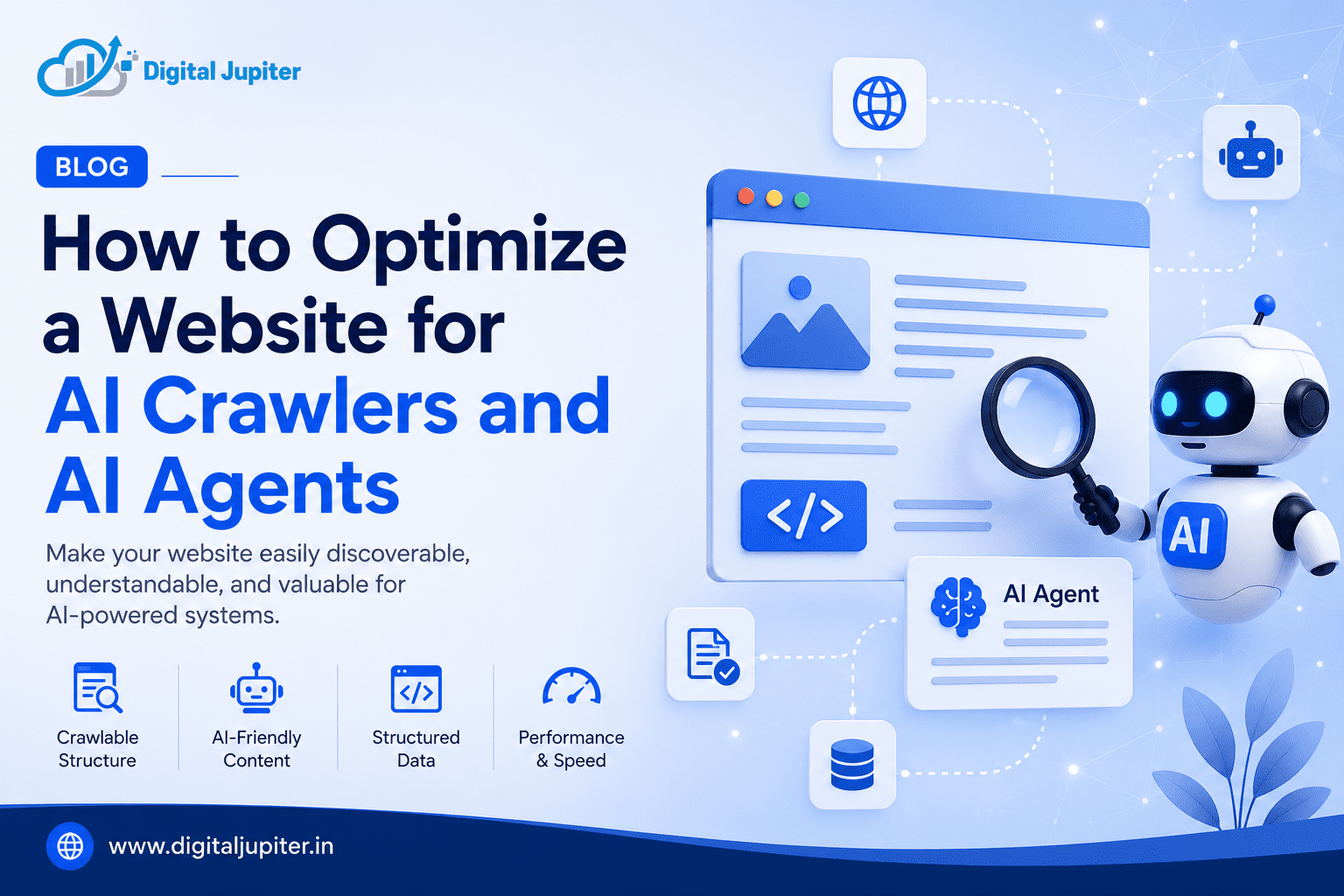
The way people search online is changing fast. Earlier, users searched Google and clicked links to websites. Now, many users ask questions directly to AI tools like OpenAI ChatGPT, Anthropic Claude, and Perplexity AI Perplexity. These AI systems read websites, collect information, and generate direct answers for users.
Imagine spending months creating valuable content, but AI crawlers cannot properly access or understand your website. Your competitors get mentioned in AI-generated answers while your website remains invisible. That is exactly why businesses are now focusing on AI crawler optimization and AI agent optimization.
If you want your website to stay visible in the AI search era, you must optimize your website not only for search engines but also for AI crawlers and AI agents.
What Are AI Crawlers and AI Agents?
AI crawlers are bots that visit websites and collect information for AI systems. Examples include GPTBot, ClaudeBot, and PerplexityBot. These crawlers analyze content, structure, metadata, and context to help AI models answer user queries.
AI agents are advanced systems that not only read information but also perform tasks, summarize content, compare data, and provide recommendations.
This means websites must now focus on both traditional SEO and AI search optimization.
Why AI SEO Matters in 2026
Traditional SEO is no longer enough. AI tools now generate answers directly inside their platforms. If your website is properly optimized, AI systems may mention your brand, summarize your content, or cite your website in responses.
This is where Generative Engine Optimization and GEO optimization become important.
According to multiple industry studies, many websites accidentally block AI crawlers through incorrect robots.txt settings, reducing their visibility in AI search systems.
Use Proper robots.txt for AI Crawlers
One of the first steps in AI crawler optimization is configuring robots.txt correctly.
A robots.txt file tells crawlers which sections of your website they can access. AI crawlers like GPTBot and ClaudeBot generally follow these instructions.
Example:
User-agent: GPTBot
Allow: /
User-agent: ClaudeBot
Allow: /
Sitemap: https://yourwebsite.com/sitemap.xml
If you accidentally block AI crawlers, your website may become invisible in AI-generated search responses.
Many businesses still use broad “Disallow” rules that unintentionally block AI bots.
Implement llms.txt for AI Understanding
Another growing trend in AI agent optimization is the use of llms.txt.
An llms.txt file is placed in the root directory of your website and helps AI systems understand your site content, expertise, and important pages.
Example structure:
# Company Overview
Digital marketing and AI SEO agency
# Important Pages
/blog/
/seo-services/
/ai-seo-guide/
Although llms.txt is still considered experimental, many SEO professionals are already implementing it as part of future-ready AI visibility strategies.
Improve AI-Friendly Website Structure
AI crawlers prefer websites with a clean and organized structure.
To improve AI-friendly website structure, focus on:
- Clear headings (H1, H2, H3)
- Short paragraphs
- Bullet points
- Simple navigation
- Internal linking
- Topic clustering
- Descriptive URLs
AI systems understand content better when pages are logically connected.
For example:
- Main Topic → AI SEO
- Subtopics → robots.txt, llms.txt, schema markup, AI indexing
This improves both user experience and AI search visibility.
Use Schema Markup for AI
Structured data plays a major role in technical SEO for AI.
Schema markup for AI helps crawlers understand:
- Business details
- Articles
- FAQs
- Reviews
- Products
- Services
- Authors
AI systems rely heavily on structured information for generating accurate answers.
Popular schema types include:
- Article Schema
- FAQ Schema
- Organization Schema
- HowTo Schema
- Breadcrumb Schema
Adding structured data improves your chances of appearing in AI-generated responses.
Create High-Quality AI Content Optimization
AI crawlers prioritize content that is:
- Helpful
- Accurate
- Easy to understand
- Well-structured
- Updated regularly
For effective AI content optimization, follow these strategies:
Use Conversational Language
AI tools prefer content written in natural language because users ask questions conversationally.
Instead of:
“Best SEO practices 2026”
Write:
“How can businesses improve SEO for AI search engines?”
Answer Questions Clearly
AI systems often extract direct answers from websites.
Add:
- Definitions
- Step-by-step explanations
- Comparisons
- Lists
- FAQs
This improves your AI search engine ranking potential.
Build Topical Authority
Publishing multiple related blogs helps AI systems understand your expertise.
Example cluster:
- AI SEO Guide
- GEO Optimization
- AI Crawlers Explained
- llms.txt Setup
- Schema Markup for AI
This strengthens your overall AI indexing and authority.
Improve Website Crawlability
Good crawlability for AI bots is essential.
Make sure your website has:
- Fast loading speed
- Mobile responsiveness
- XML sitemap
- Clean code
- HTTPS security
- Proper internal linking
Slow or poorly structured websites create crawling issues for both search engines and AI systems.
Focus on E-E-A-T Signals
AI systems prefer trustworthy content.
Strengthen:
- Experience
- Expertise
- Authority
- Trustworthiness
Ways to improve E-E-A-T:
- Add author profiles
- Publish accurate information
- Keep content updated
- Use credible statistics
- Add business information
This helps improve both traditional SEO and AI search optimization.
Monitor AI Traffic and Mentions
Businesses should now track:
- AI crawler visits
- AI-generated mentions
- Referral traffic from AI platforms
- Brand citations in AI answers
Server logs can help identify whether GPTBot, ClaudeBot, or PerplexityBot are crawling your site.
This is becoming an important part of modern GEO optimization.
The Future of AI SEO
The future of SEO will be heavily influenced by AI systems and AI-powered search experiences.
Websites that focus on:
- AI crawler optimization
- AI agent optimization
- technical SEO for AI
- structured data for AI crawlers
- AI-friendly website structure
will have a much stronger chance of appearing in AI-generated responses.
While technologies like llms.txt are still evolving, experts agree that structured content, proper crawl access, and strong topical authority are already critical for AI visibility.
Conclusion
The AI search era has already started. Businesses can no longer depend only on traditional SEO methods. To stay competitive, websites must focus on AI SEO, Generative Engine Optimization, AI search visibility, and AI crawler optimization.
By improving robots.txt for AI crawlers, implementing llms.txt, strengthening schema markup for AI, and creating strong AI-friendly website structure, businesses can improve their chances of getting discovered by AI systems.
At Digital Jupiter, businesses can explore advanced strategies for AI search optimization, GEO optimization, technical SEO for AI, AI content optimization, and long-term digital growth to stay ahead in the evolving AI-driven search landscape.